Prerequisites: Matrix, Heavy-Light Decomposition.
Dynamic DP is a piece of black magic taught by Maokun at WC2018, generally used to solve DP problems on trees with point-weight (or edge-weight) modification operations.
Example
Let us explain the process of dynamic DP using this template problem as an example.
Example Problem Luogu P4719【Template】Dynamic DP
Given a tree with vertices, each with a vertex weight. There are operations; each operation gives and changes the weight of vertex to . After each operation, you need to find the weight of the maximum-weight independent set of this tree.
Generalized Matrix Multiplication
Define generalized matrix multiplication as:
This is equivalent to replacing multiplication with addition and addition with the operation in ordinary matrix multiplication.
Generalized matrix multiplication is also associative, so matrix fast exponentiation can be used.
Without Modification Operations
Let denote the maximum answer when is not selected, and denote the maximum answer when is selected.
The DP equations are:
The answer is .
With Modification Operations
First perform heavy-light decomposition on the tree. Suppose there is a heavy chain:
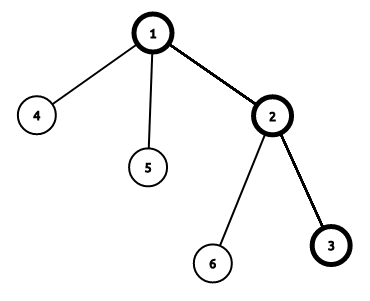
Let denote the maximum answer when is not selected and only the subtrees of 's light children may be selected; let denote the maximum answer when is selected without considering , where denotes the heavy child of .
Suppose we know . Then the DP equations are:
The answer is .
A matrix can be constructed:
Note that we use the generalized multiplication rule here.
It can be seen that during a modification operation, we only need to modify and every heavy chain above it.
Specific Approach
-
Use DFS preprocessing to calculate and .
-
Perform heavy-light decomposition on the tree (note that because querying a vertex requires calculating the interval matrix product from that vertex to the end of the heavy chain containing it, for every vertex record , representing the index of the last vertex of the heavy chain containing ). Build a segment tree for each heavy chain; the segment tree maintains the matrices and interval products of the matrices.
-
During a modification, first modify and the matrix of vertex in the segment tree, calculate the change in the matrix of , and apply the change to the matrix of .
-
A query is simply the interval product from 1 to the end of the heavy chain containing it, followed by taking a .
Code Implementation
#include <algorithm>
#include <cstring>
#include <iostream>

using namespace std;

constexpr int MAXN = 500010;
constexpr int INF = 0x3f3f3f3f;

int Begin[MAXN], Next[MAXN], To[MAXN], e, n, m;
int sz[MAXN], son[MAXN], top[MAXN], fa[MAXN], dis[MAXN], p[MAXN], id[MAXN],
    End[MAXN];
// p[i] is the index of i after heavy-light decomposition, id[p[i]] = i
int cnt, tot, a[MAXN], f[MAXN][2];

struct matrix {
  int g[2][2];

  matrix() { memset(g, 0, sizeof(g)); }

  matrix operator*(const matrix &b) const  // Overload matrix multiplication
  {
    matrix c;
    for (int i = 0; i <= 1; i++)
      for (int j = 0; j <= 1; j++)
        for (int k = 0; k <= 1; k++)
          c.g[i][j] = max(c.g[i][j], g[i][k] + b.g[k][j]);
    return c;
  }
} Tree[MAXN], g[MAXN];  // Tree[] is the constructed segment tree; g[] maintains the matrix of each vertex

void PushUp(int root) { Tree[root] = Tree[root << 1] * Tree[root << 1 | 1]; }

void Build(int root, int l, int r) {
  if (l == r) {
    Tree[root] = g[id[l]];
    return;
  }
  int Mid = (l + r) >> 1;
  Build(root << 1, l, Mid);
  Build(root << 1 | 1, Mid + 1, r);
  PushUp(root);
}

matrix Query(int root, int l, int r, int L, int R) {
  if (L <= l && r <= R) return Tree[root];
  int Mid = (l + r) >> 1;
  if (R <= Mid) return Query(root << 1, l, Mid, L, R);
  if (Mid < L) return Query(root << 1 | 1, Mid + 1, r, L, R);
  return Query(root << 1, l, Mid, L, R) *
         Query(root << 1 | 1, Mid + 1, r, L, R);
  // Note how the query operation is written
}

void Modify(int root, int l, int r, int pos) {
  if (l == r) {
    Tree[root] = g[id[l]];
    return;
  }
  int Mid = (l + r) >> 1;
  if (pos <= Mid)
    Modify(root << 1, l, Mid, pos);
  else
    Modify(root << 1 | 1, Mid + 1, r, pos);
  PushUp(root);
}

void Update(int x, int val) {
  g[x].g[1][0] += val - a[x];
  a[x] = val;
  // First modify x's g matrix
  while (x) {
    matrix last = Query(1, 1, n, p[top[x]], End[top[x]]);
    // Query the original g matrix of top[x]
    Modify(1, 1, n,
           p[x]);  // Perform the modification (the g matrix of vertex x has been modified, but the one in the segment tree has not)
    matrix now = Query(1, 1, n, p[top[x]], End[top[x]]);
    // Query the new g matrix of top[x]
    x = fa[top[x]];
    g[x].g[0][0] +=
        max(now.g[0][0], now.g[1][0]) - max(last.g[0][0], last.g[1][0]);
    g[x].g[0][1] = g[x].g[0][0];
    g[x].g[1][0] += now.g[0][0] - last.g[0][0];
    // Modify the g matrix of fa[top[x]] according to the change
  }
}

void add(int u, int v) {
  To[++e] = v;
  Next[e] = Begin[u];
  Begin[u] = e;
}

void DFS1(int u) {
  sz[u] = 1;
  int Max = 0;
  f[u][1] = a[u];
  for (int i = Begin[u]; i; i = Next[i]) {
    int v = To[i];
    if (v == fa[u]) continue;
    dis[v] = dis[u] + 1;
    fa[v] = u;
    DFS1(v);
    sz[u] += sz[v];
    if (sz[v] > Max) {
      Max = sz[v];
      son[u] = v;
    }
    f[u][1] += f[v][0];
    f[u][0] += max(f[v][0], f[v][1]);
    // Compute f[i][0/1] during DFS1 as well
  }
}

void DFS2(int u, int t) {
  top[u] = t;
  p[u] = ++cnt;
  id[cnt] = u;
  End[t] = cnt;
  g[u].g[1][0] = a[u];
  g[u].g[1][1] = -INF;
  if (!son[u]) return;
  DFS2(son[u], t);
  for (int i = Begin[u]; i; i = Next[i]) {
    int v = To[i];
    if (v == fa[u] || v == son[u]) continue;
    DFS2(v, v);
    g[u].g[0][0] += max(f[v][0], f[v][1]);
    g[u].g[1][0] += f[v][0];
    // Obtain the g matrix from f[i][0/1]
  }
  g[u].g[0][1] = g[u].g[0][0];
}

int main() {
  cin.tie(nullptr)->sync_with_stdio(false);
  cin >> n >> m;
  for (int i = 1; i <= n; i++) cin >> a[i];
  for (int i = 1; i <= n - 1; i++) {
    int u, v;
    cin >> u >> v;
    add(u, v);
    add(v, u);
  }
  dis[1] = 1;
  DFS1(1);
  DFS2(1, 1);
  Build(1, 1, n);
  for (int i = 1; i <= m; i++) {
    int x, val;
    cin >> x >> val;
    Update(x, val);
    matrix ans = Query(1, 1, n, 1, End[1]);  // Query the matrix product of the heavy chain containing 1
    cout << max(ans.g[0][0], ans.g[1][0]) << '\n';
  }
  return 0;
}