Introduction
std::bitset is a fixed-size container in the standard library for storing 0/1 values. Strictly speaking, it is not part of the STL.
bitset and the STL
The C++ standard library provides some special container classes, the so-called container adapters (stack, queue, priority queue). In addition, a few classes provide a container-like interface (for example, strings, bitsets, and valarrays). All these classes are covered separately.1 Container adapters and bitsets are covered in Chapter 12.
The C++ standard library provides not only the containers for the STL framework but also some containers that fit some special needs and provide simple, almost self-explanatory, interfaces. You can group these containers into either the so-called container adapters, which adapt standard STL containers to fit special needs, or a bitset, which is a containers for bits or Boolean values. There are three standard container adapters: stacks, queues, and priority queues. In priority queues, the elements are sorted automatically according to a sorting criterion. Thus, the "next" element of a priority queue is the element with the "highest" value. A bitset is a bitfield with an arbitrary but fixed number of bits. Note that the C++ standard library also provides a special container with a variable size for Boolean values: vector.
——Quoted from The C++ Standard Library 2nd Edition
This shows that bitset is not part of the STL, but is a "Special Container" in the standard library. In fact, as a container, it does not satisfy the requirements for STL containers. Calling it an adapter would also be inaccurate, since it does not use another STL container as its underlying implementation.
Because memory addresses are byte-addressed, rather than bit-addressed, a variable of type bool, although it can represent only 0/1, still occupies 1 byte of memory.
bitset uses fixed optimization so that the eight bits in one byte can separately store 8 bits of 0/1.
For a 4-byte int variable, when storing only 0/1 values, a bitset uses only of the space, and the time required to compute some information is also of that for the int.
In some cases, bitset can improve program runtime. Whether it optimizes the complexity or only the constant depends on how computational complexity is viewed. In general, the complexity of bitset can be written in several ways (assuming the original complexity is ):
- . This notation considers
bitsetnot to optimize the complexity at all. - . This notation is not rigorous (complexity should not contain constants), but reflects that
bitsetcan reduce the required time to . - , where (the number of bits in the computer). This notation is more widely accepted.
- , where is the size of an integer variable on the computer.
In addition, the storage method of the vector specialization vector<bool> is the same as that of bitset. The difference is that it supports dynamically allocating space, while bitset, like an ordinary static array, is allocated at compile time. However, bitset has some useful library functions that are not only convenient but can sometimes enable SIMD and thus reduce constants. In addition, some behavior of vector<bool> differs from that of vector (for example, for std::vector<bool> vec, &vec[0] + i is not equal to &vec[i]). Therefore, vector<bool> is generally not used.
Usage
See std::bitset - cppreference.com.
Header
#include <bitset>
Specifying the size
std::bitset<1000> bs; // a bitset with 1000 bits
Constructors
bitset(): Every bit isfalse.bitset(unsigned long val): Set to the binary form ofval.bitset(const string& str): Set to the stringstr.
Operators
-
operator []: Access a specific bit. -
operator ==/operator !=: Compare whether the contents of twobitsets are exactly the same. -
operator &/operator &=/operator |/operator |=/operator ^/operator ^=/operator ~: Perform bitwise AND/OR/XOR/NOT operations.Note:
bitsetcan only perform bitwise operations with anotherbitset. To perform bitwise operations with an integer type, first convert the integer to abitset. -
operator <</operator >>/operator <<=/operator >>=: Perform binary left/right shifts.
In addition, bitset supports C++ stream I/O, which means that input and output can be performed through cin/cout.
Member functions
count(): Return the number oftruebits.size(): Return the size of thebitset.test(pos): Has the same function asvector'sat(); unlike the[]operator, it performs bounds checking.any(): Returntrueif any bit istrue, andfalseotherwise.none(): If all bits arefalse, returntrue; otherwise returnfalse.all(): Returntrueif all bits aretrue, andfalseotherwise.-
set(): Set the entirebitsettotrue.set(pos, val = true): Set one bit totrue/false.
-
reset(): Set the entirebitsettofalse.reset(pos): Set one bit tofalse. Equivalent toset(pos, false).
-
flip(): Flip every bit. (, equivalent to XORing with an all-bitset.)flip(pos): Flip one bit.
to_string(): Return the converted string representation.to_ulong(): Return the convertedunsigned longrepresentation (longis the same asinton NT and 32-bit POSIX systems, and the same aslong longon 64-bit POSIX systems).to_ullong(): (Since C++11) Return the convertedunsigned long longrepresentation.
In addition, libstdc++ has several useful internal member functions1:
_Find_first(): For thebitset, return the index of its firsttrue; if there is notrue, return the size of thebitset._Find_next(pos): Forpos, after it (at an index strictly greater thanpos), return the index of the firsttrue; if afterposthere is notrue, return the size of thebitset.
Applications
LibreOJ β Round #2: Greedy Only Passes the Sample
This problem can be solved with DP, and the transition equation is very simple:
indicates whether the sum of the squares of the first numbers can be , so (ORed together).
However, a direct solution takes time and seemingly cannot pass.
We can optimize it with bitset: just shift left and OR.
Submission: std::bitset
#include <bitset>
#include <cstdio>
#include <iostream>

using namespace std;

constexpr int N = 101;

int n, a[N], b[N];
bitset<N * N * N> f[N];

int main() {
  int i, j;

  cin >> n;

  for (i = 1; i <= n; ++i) cin >> a[i] >> b[i];

  f[0][0] = 1;

  for (i = 1; i <= n; ++i) {
    for (j = a[i]; j <= b[i]; ++j) {
      f[i] |= (f[i - 1] << (j * j));
    }
  }

  cout << f[n].count();

  return 0;
}
Since the libstdc++ implementation packs __CHAR_BIT__ * sizeof(unsigned long) bits2, which is on some platforms, we can hand-write a bitset (only needing to support shifting left and ORing) that packs bits (__CHAR_BIT__ * sizeof(unsigned long long)) for further optimization:
Submission: hand-written bitset
#include <cstdio>
#include <iostream>

using namespace std;

constexpr int N = 101;
constexpr int W = 64;

struct Bitset {
  unsigned long long a[N * N * N >> 6];

  void shiftor(const Bitset &y, int p, int l, int r) {
    int t = p - p / W * W;
    int tt = (t == 0 ? 0 : W - t);
    int to = (r + p) / W;
    int qaq = (p + W - 1) / W;

    for (int i = (l + p) / W; i <= to; ++i) {
      if (i - qaq >= 0) a[i] |= y.a[i - qaq] >> tt;

      a[i] |= ((y.a[i - qaq + 1] & ((1ull << tt) - 1)) << t);
    }
  }
} f[N];

int main() {
  int n, a, b, l = 0, r = 0, ans = 0;

  scanf("%d", &n);

  f[0].a[0] = 1;

  for (int i = 1; i <= n; ++i) {
    scanf("%d%d", &a, &b);

    for (int j = a; j <= b; ++j) f[i].shiftor(f[i - 1], j * j, l, r);

    l += a * a;
    r += b * b;
  }

  for (int i = l / W; i <= r / W; ++i)
    ans += __builtin_popcount(f[n].a[i] & 0xffffffffu) +
           __builtin_popcount(f[n].a[i] >> 32);

  printf("%d", ans);

  return 0;
}
In addition, a brute-force solution with several pruning techniques can also pass:
Submission: brute force with several pruning techniques
#include <cstdio>
#include <iostream>

using namespace std;

constexpr int N = 101;
constexpr int W = 64;

bool f[N * N * N];

int main() {
  int n, i, j, k, a, b, l = 0, r = 0, ans = 0;

  scanf("%d", &n);

  f[0] = true;

  for (i = 1; i <= n; ++i) {
    scanf("%d%d", &a, &b);
    l += a * a;
    r += b * b;

    for (j = r; j >= l; --j) {
      f[j] = false;

      for (k = a; k <= b; ++k) {
        if (j - k * k < l - a * a) break;

        if (f[j - k * k]) {
          f[j] = true;
          break;
        }
      }
    }
  }

  for (i = l; i <= r; ++i) ans += f[i];

  printf("%d", ans);

  return 0;
}
CF1097F Alex and a TV Show
Problem statement
You are given multisets and four types of operations:
- Set a multiset to a number.
- Set a multiset to the sum of two other multisets.
- Set a multiset to the of one number selected from each of two other multisets. That is, .
- Query the number of occurrences of a number in a multiset, modulo 2.
The number of multisets is , the number of operations is , and the value range is .
Solution
Seeing ‘modulo ’ suggests maintaining each multiset with a bitset.
Then operation is a direct assignment, operation is XOR (because of modulo ), and operation is a direct query. But what about operation ?
We can try to maintain the multiset consisting of all divisors of every element in each multiset. Then operation becomes a direct bitwise AND.
We can precompute the bitset of divisors for every number in the value range, which solves operation . Operation is still XOR.
The problem now is how to obtain the number of occurrences of a number in a multiset from the multiset of its divisors.
Let the original multiset be , and let the multiset of its divisors be . We want the number of occurrences in of . Applying Möbius inversion, we get:
Because this is modulo , and are the same, so we only need to check whether has a square factor. Therefore, for every number in the value range, we can precompute a bitset consisting of the multiples of that number whose quotient after division by it is square-free. When obtaining the answer, simply take the bitwise AND first and then call count().
Then the complexity of a single query is ().
For preprocessing, or preprocessing is relatively simple. The preprocessing shown in the code below has harmonic-series complexity, so it is .
Reference code
#include <bitset>
#include <cctype>
#include <cmath>
#include <cstdio>
#include <iostream>

using namespace std;

int read() {
  int out = 0;
  char c;
  while (!isdigit(c = getchar()));
  for (; isdigit(c); c = getchar()) out = out * 10 + c - '0';
  return out;
}

constexpr int N = 100005;
constexpr int M = 1000005;
constexpr int V = 7005;

bitset<V> pre[V], pre2[V], a[N], mu;
int n, m, tot;
char ans[M];

int main() {
  int i, j, x, y, z;

  n = read();
  m = read();

  mu.set();
  for (i = 2; i * i < V; ++i) {
    for (j = 1; i * i * j < V; ++j) {
      mu[i * i * j] = 0;
    }
  }
  for (i = 1; i < V; ++i) {
    for (j = 1; i * j < V; ++j) {
      pre[i * j][i] = 1;
      pre2[i][i * j] = mu[j];
    }
  }

  while (m--) {
    switch (read()) {
      case 1:
        x = read();
        y = read();
        a[x] = pre[y];
        break;
      case 2:
        x = read();
        y = read();
        z = read();
        a[x] = a[y] ^ a[z];
        break;
      case 3:
        x = read();
        y = read();
        z = read();
        a[x] = a[y] & a[z];
        break;
      case 4:
        x = read();
        y = read();
        ans[tot++] = ((a[x] & pre2[y]).count() & 1) + '0';
        break;
    }
  }

  printf("%s", ans);

  return 0;
}
Combining with the sieve of Eratosthenes
Because of its fast sequential read and write performance, bitset is particularly suitable for combining with the sieve of Eratosthenes to build a table of primes.
The method is also simple: just replace the Boolean array in the sieve of Eratosthenes with a bitset.
Benchmark
The benchmark uses Quick C++ Benchmarks, with GCC 13.2 as the compiler and -std=c++20 -O2 as compilation parameters.
| Algorithm | Function name |
|---|---|
| Sieve of Eratosthenes + C-style Boolean array, without storing the sieved primes | Eratosthenes_CArray |
Sieve of Eratosthenes + vector<bool>, without storing the sieved primes | Eratosthenes_vector |
Sieve of Eratosthenes + bitset, without storing the sieved primes | Eratosthenes_bitset |
| Sieve of Eratosthenes + C-style Boolean array, storing the sieved primes | Eratosthenes_CArray_sp |
Sieve of Eratosthenes + vector<bool>, storing the sieved primes | Eratosthenes_vector_sp |
Sieve of Eratosthenes + bitset, storing the sieved primes | Eratosthenes_bitset_sp |
| Euler sieve + C-style Boolean array | Euler_CArray |
Euler sieve + vector<bool> | Euler_vector |
Euler sieve + bitset | Euler_bitset |
-
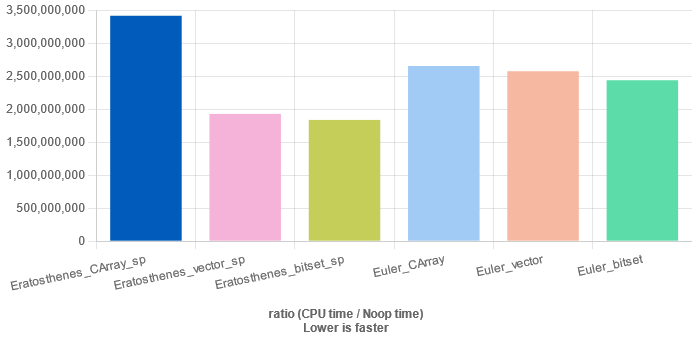
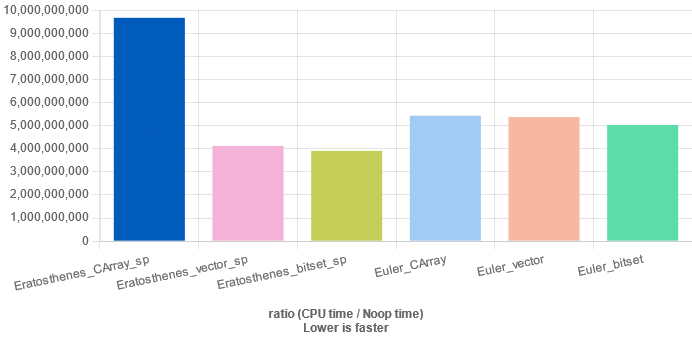
When the sieve of Eratosthenes stores the sieved primes:
-
For , benchmark results:
-
For , benchmark results:
-
-
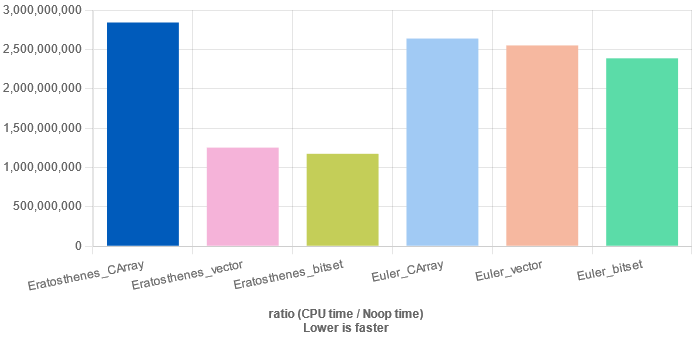
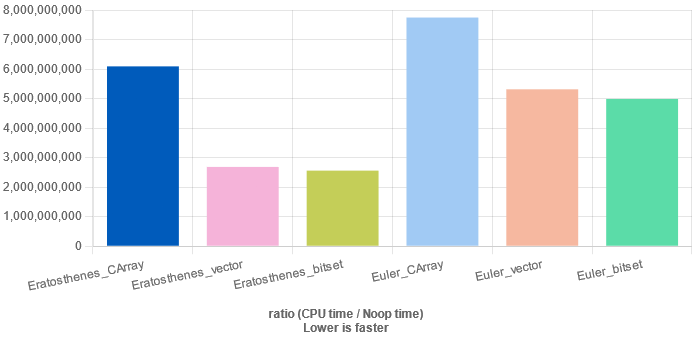
When the sieve of Eratosthenes does not store the sieved primes:
-
For , benchmark results:
-
For , benchmark results:
-
The benchmark results show:
- After optimization with
bitsetorvector<bool>, the sieve of Eratosthenes with time complexity can even outperform the Euler sieve with time complexity ; - In most cases, the optimization effect of using
bitsetorvector<bool>with the Euler sieve is not obvious; - The optimization effect of
bitsetis slightly stronger than that ofvector<bool>.
Reference code
Install google/benchmark first.
#include <benchmark/benchmark.h>
#include <bits/stdc++.h>
using namespace std;
using u32 = uint32_t;
using u64 = uint64_t;

#define ERATOSTHENES_STORAGE_PRIME
#define ENABLE_EULER
constexpr u32 N = 5e7 + 1;

#ifndef ERATOSTHENES_STORAGE_PRIME

void Eratosthenes_CArray(benchmark::State &state) {
  static bool is_prime[N];
  for (auto _ : state) {
    fill(is_prime, is_prime + N, true);
    is_prime[0] = is_prime[1] = false;
    for (u32 i = 2; (u64)i * i < N; ++i)
      if (is_prime[i])
        for (u32 j = i * i; j < N; j += i) is_prime[j] = false;
    benchmark::DoNotOptimize(0);
  }
}

BENCHMARK(Eratosthenes_CArray);

void Eratosthenes_vector(benchmark::State &state) {
  static vector<bool> is_prime(N);
  for (auto _ : state) {
    fill(is_prime.begin(), is_prime.end(), true);
    is_prime[0] = is_prime[1] = false;
    for (u32 i = 2; (u64)i * i < N; ++i)
      if (is_prime[i])
        for (u32 j = i * i; j < N; j += i) is_prime[j] = false;
    benchmark::DoNotOptimize(0);
  }
}

BENCHMARK(Eratosthenes_vector);

void Eratosthenes_bitset(benchmark::State &state) {
  static bitset<N> is_prime;
  for (auto _ : state) {
    is_prime.set();
    is_prime.reset(0);
    is_prime.reset(1);
    for (u32 i = 2; (u64)i * i < N; ++i)
      if (is_prime[i])
        for (u32 j = i * i; j < N; j += i) is_prime.reset(j);
    benchmark::DoNotOptimize(0);
  }
}

BENCHMARK(Eratosthenes_bitset);

#else

void Eratosthenes_CArray_sp(benchmark::State &state) {
  static bool is_prime[N];
  for (auto _ : state) {
    vector<u32> prime;
    fill(is_prime, is_prime + N, true);
    is_prime[0] = is_prime[1] = false;
    for (u32 i = 2; (u64)i * i < N; ++i)
      if (is_prime[i])
        for (u32 j = i * i; j < N; j += i) is_prime[j] = false;
    for (u32 i = 2; i < N; ++i)
      if (is_prime[i]) prime.push_back(i);
    benchmark::DoNotOptimize(prime);
  }
}

BENCHMARK(Eratosthenes_CArray_sp);

void Eratosthenes_vector_sp(benchmark::State &state) {
  static vector<bool> is_prime(N);
  for (auto _ : state) {
    vector<u32> prime;
    fill(is_prime.begin(), is_prime.end(), true);
    is_prime[0] = is_prime[1] = false;
    for (u32 i = 2; (u64)i * i < N; ++i)
      if (is_prime[i])
        for (u32 j = i * i; j < N; j += i) is_prime[j] = false;
    for (u32 i = 2; i < N; ++i)
      if (is_prime[i]) prime.push_back(i);
    benchmark::DoNotOptimize(prime);
  }
}

BENCHMARK(Eratosthenes_vector_sp);

void Eratosthenes_bitset_sp(benchmark::State &state) {
  static bitset<N> is_prime;
  for (auto _ : state) {
    vector<u32> prime;
    is_prime.set();
    is_prime.reset(0);
    is_prime.reset(1);
    for (u32 i = 2; (u64)i * i < N; ++i)
      if (is_prime[i])
        for (u32 j = i * i; j < N; j += i) is_prime.reset(j);
    for (u32 i = 2; i < N; ++i)
      if (is_prime[i]) prime.push_back(i);
    benchmark::DoNotOptimize(prime);
  }
}

BENCHMARK(Eratosthenes_bitset_sp);

#endif

#ifdef ENABLE_EULER

void Euler_CArray(benchmark::State &state) {
  static bool not_prime[N];
  for (auto _ : state) {
    vector<u32> prime;
    fill(not_prime, not_prime + N, false);
    not_prime[0] = not_prime[1] = true;
    for (u32 i = 2; i < N; ++i) {
      if (!not_prime[i]) prime.push_back(i);
      for (u32 pri_j : prime) {
        if (i * pri_j >= N) break;
        not_prime[i * pri_j] = true;
        if (i % pri_j == 0) break;
      }
    }
    benchmark::DoNotOptimize(prime);
  }
}

BENCHMARK(Euler_CArray);

void Euler_vector(benchmark::State &state) {
  static vector<bool> not_prime(N);
  for (auto _ : state) {
    vector<u32> prime;
    fill(not_prime.begin(), not_prime.end(), false);
    not_prime[0] = not_prime[1] = true;
    for (u32 i = 2; i < N; ++i) {
      if (!not_prime[i]) prime.push_back(i);
      for (u32 pri_j : prime) {
        if (i * pri_j >= N) break;
        not_prime[i * pri_j] = true;
        if (i % pri_j == 0) break;
      }
    }
    benchmark::DoNotOptimize(prime);
  }
}

BENCHMARK(Euler_vector);

void Euler_bitset(benchmark::State &state) {
  static bitset<N> not_prime;
  for (auto _ : state) {
    vector<u32> prime;
    not_prime.reset();
    not_prime.set(0);
    not_prime.set(1);
    for (u32 i = 2; i < N; ++i) {
      if (!not_prime[i]) prime.push_back(i);
      for (u32 pri_j : prime) {
        if (i * pri_j >= N) break;
        not_prime.set(i * pri_j);
        if (i % pri_j == 0) break;
      }
    }
    benchmark::DoNotOptimize(prime);
  }
}

BENCHMARK(Euler_bitset);

#endif

static void Noop(benchmark::State &state) {
  for (auto _ : state) benchmark::DoNotOptimize(0);
}

BENCHMARK(Noop);
BENCHMARK_MAIN();
Combining with tree decomposition
Combining bitset with tree decomposition can solve a class of problems that ask for the sum of information on multiple paths in a tree. See Data Structures/Tree Decomposition for details.
Combining with Mo's algorithm
See Miscellaneous/Mo's Algorithm with bitset for details.
Computing high-dimensional partial orders
See the FHR slides for details.